Quick Reviews: Christmas Card Games
It's that time of year again where people are opening Christmas cards (or sending them if you're not on the ball earlier) and so this seemed like a great time to talk about some card-based games that I've been trying out in the later part of 2025; these are mostly some games that had been sitting on my backlog for quite a while so they may not be new, but they're new to me. Three of them have been talked about in Lite Switch episodes and one was a recent Steam sale acquisition, so let's talk about Marvel Snap, Inscryption, Slay the Spire, and Deck of Haunts.
Marvel Snap

We start off with Marvel Snap, and people listening to the show would have heard Jaymo gushing about Marvel Snap for quite some time. And it's been pretty roundly popular since coming out in October 2022. A free-to-play game that feels heavy on the microtransactions, the central mechanic is fighting for control of three locations using decks of twelve cards from the very broad Marvel world of characters.
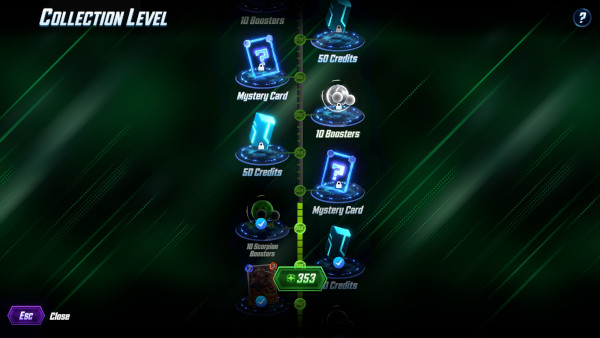
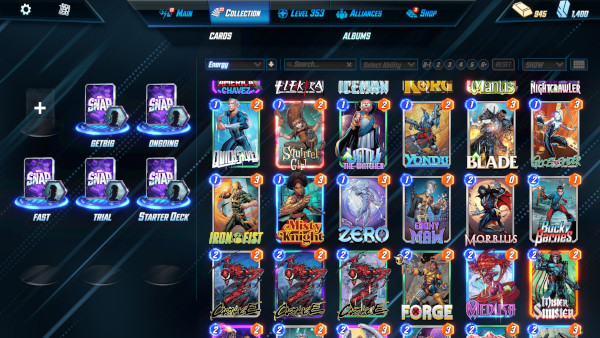
For someone who really has a lot of connection to a lot of these characters (and can go deep in the casting), I can see some of the appeal on this. The vast majority of the characters I get, though, I don't have that response, so just getting more characters in and of itself isn't particularly fulfilling for me. Part of this is that because most of the cards I get are "mystery cards", I really wasn't able to build up cards to go with specific strategies but just deal with what comes. The other part of it is that a lot of it focuses on updating the cards you already have. So you can (and really, need to) update cards so that the characters can extend outside of the card's borders and add additional features - and for me I just don't care about that cosmetic stuff and it's a bit of a pain to keep dealing with that trying to see if I can get useful cards for how I play. So for me, getting new cards feels more frustrating than satisfying.
So the other part is the gameplay, either the regular game or the special events that they run where there's custom rules designed to tweak the game. And I just don't find the gameplay satisfying. The games only last 6 turns usually, and the first three turns generally have things changing as the special abilities of each area are revealed. It's sufficiently out of my control and sufficiently fast that I don't feel like strategy can set in the way I think of it as setting in for other vs card games (from Magic the Gathering to digital card games like Scrolls or Faeria). It feels to me more like a more convoluted blackjack than a more strategic card game, and there's some thing really frustrating to see cards I'd like, but generally would need money, or loot boxes, or luck to get in the first place because it means it does feel as a new player like I'm at a permanent disadvantage. I did try to give this enough time for the gameplay to hook me, and I put in like 20 hours into this. But I never found the gameplay satisfying to me - wins often felt like luck rather than anything on my strategy that'd really click with me the way other card games do.
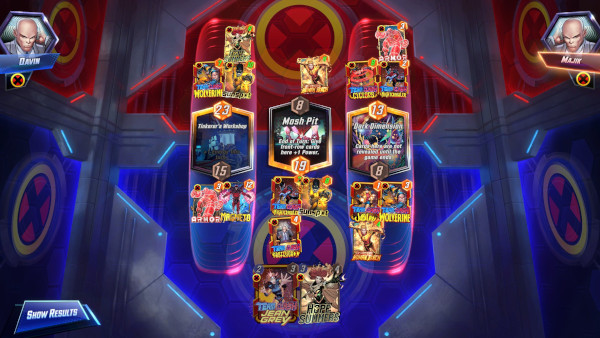
I can see why people who are really into Marvel enjoy Marvel Snap even just based on the depth of characters that are present in here. For me, though, the limitations in getting useful cards and the general gameplay not being something I enjoyed made this feel unsatisfying to me. It's just not the sort of card game that provides what I'm looking for or that makes it worthwhile for me.
Inscryption
Inscryption is a roguelike card-game that came out in October 2021, and it's been sitting in my Steam inventory from that very month. I can't remember quite what sold me on it, but I wouldn't be surprised if one of the reasons I picked this up was that it was developed by Daniel Mullins Games, and Daniel Mullins was also the developer for 2016's Pony Island. If you know one of those games, you have a bit of an idea of what is in store with the other, and so I'm glad that when I finally got around to playing Inscryption this year I didn't remember the connection to Pony Island and so I wasn't really expecting anything in particular (and I'm going to try to stay somewhat vague in this review).
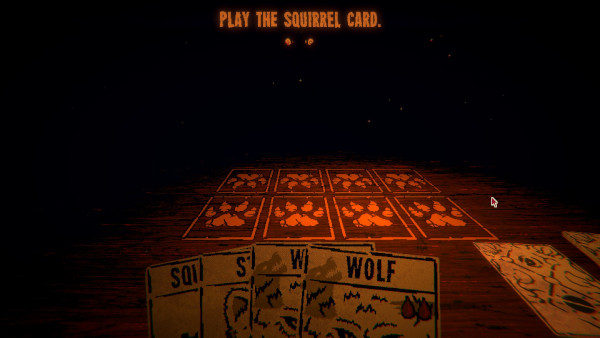
The game starts off playing a basic card game at a table in what is a very atmospheric setting. I do like that this has this slow way of rolling out new roles, so it gives off the sense of a more dynamic tutorial - much like the lighting in that image, there's a clear part of gameplay in the light, and mechanics are slowly being brought into the light as you play more. And not only is this atmospheric, I also just broadly like the aesthetic of the game. Those cards, for example, look great. Beating one level then starts to allow for the exploration of a map; some of the places are just more card battles and others are additional special events. The base idea is playing animals to defeat the animals of the opponent (so in that sense it feels like a traditional card game to me).
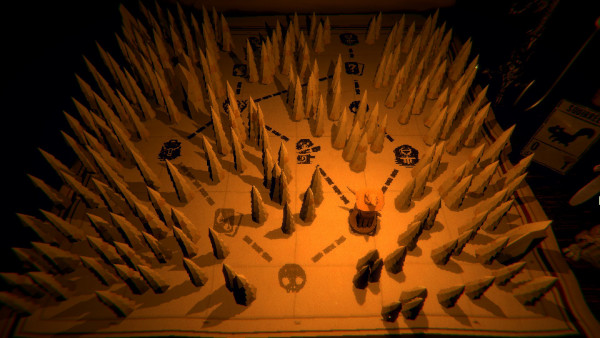
On par with Mullins other work, though, the game expands in ways that are not obvious from the start. And for me it's a bit of a mixed bag depending on what one is after in a game. Narratively, this does some interesting things and I definitely was engaged to see where that'd go. However, I'm not sure that the gameplay holds up through all of that, and I find myself unmotivated to go back to gameplay to try to get all the achievements I'm missing, because it feels like the narrative clashes somewhat with achievements (and I think some frustration also stems from UI issues I had of it taking single clicks as two clicks sometimes and selecting stuff I didn't mean to, especially when adding to my deck). For me, it's a bit annoying to leave the achievements like that... but the narrative made this worth playing and the attention this got because of it certainly would be deserved. Though what makes this interesting is also why I'm curious to see what one of Mullins' next games, Pony Island 2: Panda Circus, will be like and where that'll go.
Slay the Spire
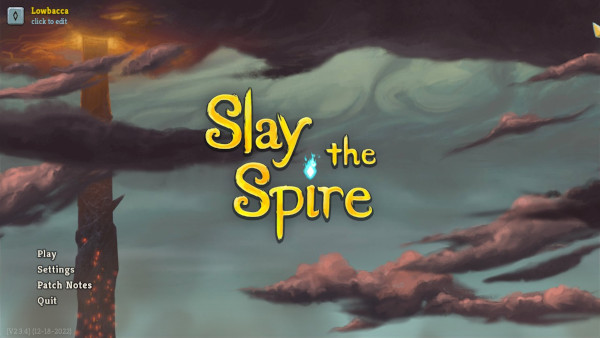
Yet another of my backlog of roguelike deckbuilder games, Slay the Spire came out in 2020 from Mega Crit and has been sitting in my Steam Library since summer of 2021. And thanks to repeated discussions of this game by a few other podcasts, specifically The Cable Club League and Overthinking Games, I finally decided to check it out this year. I went into this not knowing too much about it, beyond having some idea that ascension levels were a thing, and so if Inscryption is thought of as being primarily about a rougelike with a narrative core to it, Slay the Spire thus far (and "thus far" is now 50 hours) has been a lot more about a solid gameplay structure that's much more focused on replaying, getting to know the mechanics better, and come up with better strategies.
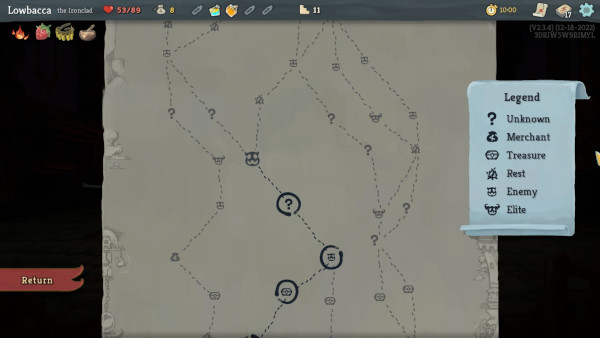
Much as in Inscyrption, there's a world map of paths with the nodes being battles and a whole bunch of other options. And this feels like much of this hinges on the ability to use all those nodes to shape your deck to your advantage. Here, the player controls a single character and the cards are things like attacks and defenses, so shaping the deck is shaping the play style. I roughly think of the two main things shaping a playthrough as the deck itself, which represents the characters actions, and the relics that you can also get which are items that are generally always present (some have constant impacts, some just repeatedly trigger). When you add the one-time-use potions and the innate abilities of the character you choose into this as well, there's a lot of variables at play and so it took me quite a while to feel like I was starting to get the hang of this.
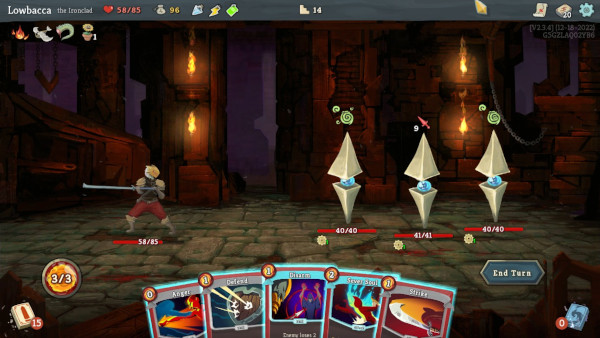
After about 8-10 hours, this began to click for me as I was starting to get a handle of the first character and that meant I was able to find the sorts of synergies that were needed to get successful runs, and somewhere after that I did finally get a successful run with a bit of luck from the relics and I've won a few times with that character, and that has felt satisfying because those victories have usually come from feeling like runs where I figured out a synergy from the options I've had (and it's been different synergies, so there's a variety there). I've also gotten to reach the ascension levels, which as it turns out is basically a difficulty mechanism.... so beating it on an ascension level unlocks the next level with additional difficulties (e.g. some enemies have more health). I still haven't beaten this with at least two of the of the other characters that I have available (I've not looked things up to see how many characters there are in total), but to me that speaks to how just how much replayability this has. Even 50 hours in, I find myself continuing to come back, primarily working my way up the ascension levels of one character but also wanting to figure out how to work the abilities of the other characters best to start winning more with them as well. Slay the Spire 2 is supposed to be coming out in spring 2026, but I think this version is good enough that I think this is worth checking out even with the sequel coming soon.
Deck of Haunts
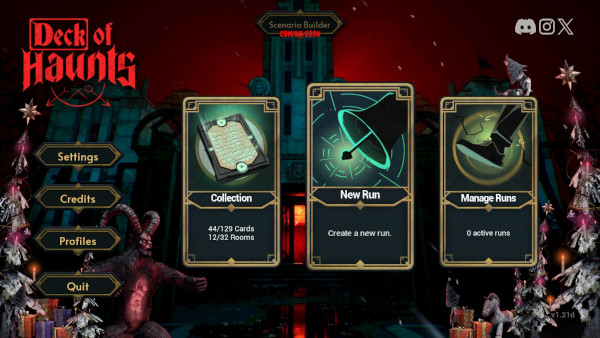
The last card game is Deck of Haunts, and it's the newest game, having come out on Steam in May 2025 and that I picked up during Steam's Winter Sale because I didn't already have enough roguelike deck builders. Being the newest game for me, it's also the one that I have the fewest hours on. What is interesting to this is that this isn't really a deck builder so much as it is a decks builder (sort of). The elevator pitch of this really appeals to me - you're in charge of a haunted house that you're designing to best eliminate intruders. So on some level it reminds me of Tomb of Tyrants (2015), where you're basically building a dungeon to stop explorers but in that case using match-3 to build on to the dungeon. It also has the same sort of starting point that made me hopeful for Afterlife Empire (also 2015), which I'd seen pitched as like Theme Hospital but with a haunted house, but that game ended up too buggy to really have a payoff. This is a lot darker than the visual look of the latter, but unfortunately shares the same pattern of bugs. Though I'm hoping that this game is new enough that we'll see it get polished up over the coming months and it has a chance still to live up to potential.
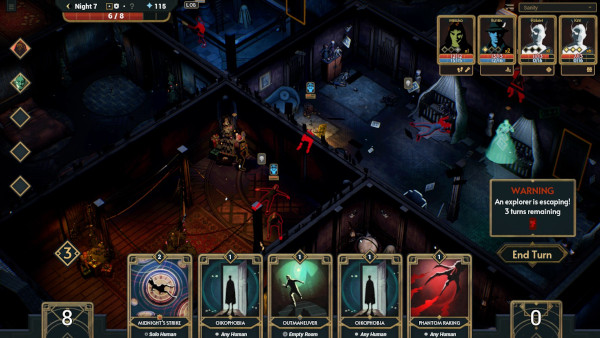
The core structure of the gameplay is that during the day, you can build up on the house, and then at night people enter the house and you need to prevent them from reaching the heart of the house (you can roughly think about this in terms of a tower defense, in the sense that you're trying to incapacitate humans before they reach the heart, and if they get there they do damage to it). It starts off with a single person, and gradually the numbers get more plentiful, the humans have more special abilities, and special classes like police and priests start showing up. There's two ways to stop them - either kill them or drive them insane. That can be done either passively with how the house has been built up or by playing cards, as there's a turn-based cycle during the night between playing cards and then all the humans getting to move. At the end of a night, there's the option to choose from either a card for the deck of nightly actions or a card that is one-time-use for building up the house, so there's two separate sets of cards to choose from.
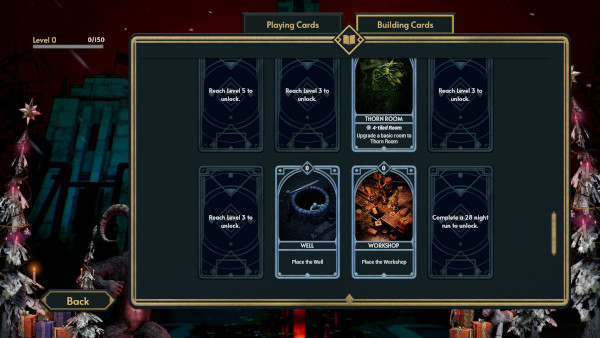
The rooms are somewhat interesting, although it's sometimes a bit opaque what they do. Mousing over will identify some of the terms on the card, but I don't think the game explains enough of the mechanics for just definitions to cut it (there really should be an easy-to-find glossary somewhere). For example, a lot matters about if rooms are explored or investigated or whatnot, and I think I've seen both terms in-game but without anything really defining them clearly to me. Similarly, some of these allow for creatures to show up, and I don't think there's a way to see what those creatures are, either. As I've played more, it does also feel a bit frustrating to get cards to upgrade rooms you don't yet have, because it only is one card per night. I still don't feel like I fully get how a lot of these rooms are intended to work, though I'm slowly filling up the empty card slots in the collection.
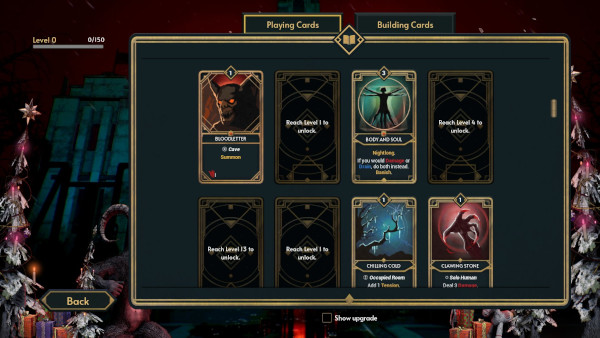
The other cards are the nightly action cards, and this works more as expected, where you draw cards, work through that turn, discard what's left, draw new cards, and then the deck cycles when you go through your draw pile. Roughly, the cards I've seen have been cards that do or modify damage to humans, cards that do or modify draining sanity of humans and cards that summon creatures (that have their own abilities). These are the cards you deal with nightly and work through the deck, so this is the central deck of the game. Both kinds of cards get unlocked as you play more - some I think are from specific tasks and others are from leveling up your account (the latter not unlike how Slay the Spire does it).
Of all the games in this review, this is the one that I feel like comes up the shortest on communicating the mechanics. There's a lot that I think I have the gist of, but I really think it needs the information somewhere easily accessible in-game. It also feels really buggy to me. Right off the bat, this listed controller support and I had initially started playing it that way, but I gave up on that because there were parts of the interface I just couldn't figure out how to interact with, particularly when I wanted to mouse over my creatures. I also hit a few different kinds of errors in gameplay - I had at least one game end because the game just crashed and I had another game where I had to quit and restart because the end of the night never triggered (I had eliminated all humans, but just kept drawing cards and getting more turns even though there was nothing to do). It's really frustrating to have a successful night and then have the game fail to recognize that and need to redo it. When I looked into this, I found people having a lot of other errors, and the devs seem to be working on those, so I'm hoping that's a sign of active development that'll iron a lot of this out. It does mean, though, that right now Decks of Haunts feels like it's at the point where I'd understand anyone that keeps their distance and waits to see over the coming months to see if more of the kinks get ironed out and the documentation improves (even if it's fan-documentation - the one fan wiki I checked out didn't help me for the questions I had). This is the only game on Steam from Mantis, so I'm hoping some of this is just needing to build experience and the product will improve in time.
Recap
Marvel Snap really just failed to deliver for me, even (or maybe partially because) it's a free to play game with optional microtransactions. Though for people who want to check it out, it's on Steam and available on mobile as well.
Inscryption doesn't feel like it has a lot of replayability and trying to complete the achievements seems unfulfilling (not an issue on Nintendo), but the narrative is interesting enough that I think it's still worth checking out for that sake. Inscryption is available on numerous platforms, including Steam and the Nintendo Switch.
By far the most playable and replayable of these games is Slay the Spire, and it feels like the mechanics are pretty quick to pick up on but with a lot of time to really get the hang of how to get things synergizing to have successful runs. Slay the Spire is also on multiple platforms, including mobile, Steam, and the Nintendo Switch. I think this is worth picking up even with the sequel coming out next year, and it's even easier to justify as this seems to often be on sale.
Deck of Haunts certainly has potential, but right now I think the better option is to keep an eye on this and see if the devs continue to release updates over the next few months and keep an eye on how many people are talking about bugs. I'd really like to see this become successful, but it's hard to recommend with how opaque and buggy it felt (which, to be fair, isn't massively buggy - but multiple bugs requiring restarts in the ~5 hours I've played it feels too high). This one is listed as being on a bunch of platforms, so maybe it's more stable on other platforms versus Steam/Windows, though the controls feel like they'd be an even bigger issue in that case. Those platforms include Steam, and while Nintendo Switch is listed as one of them, I can't find this on the Nintendo Store currently.
Quick Reviews: Flipping, Fishing, and Glamping